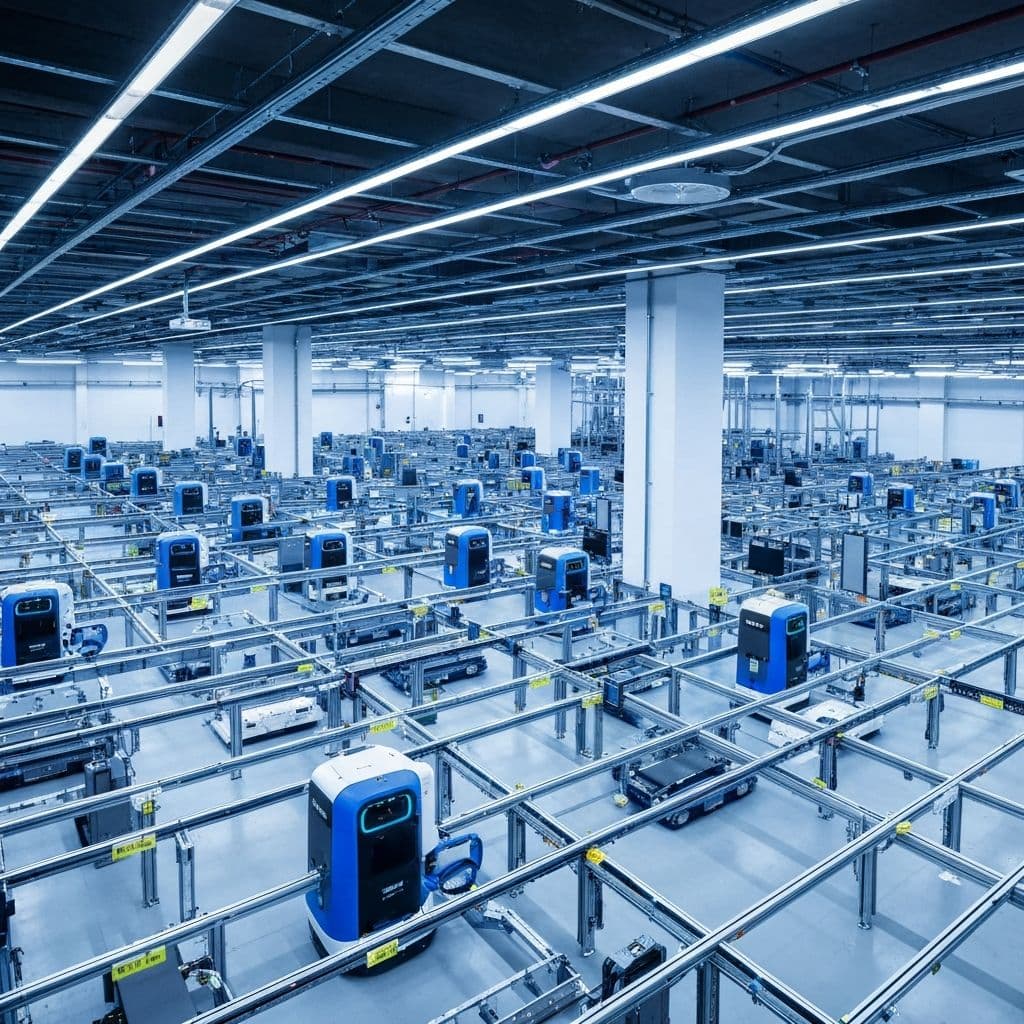
Inside the Autonomous Warehouse
Three generations of warehouse automation in a decade. The hardware is almost secondary now. It's the software doing the heavy lifting.
Ocado's Erith facility (563,000 square feet of it, on the Thames in Southeast London) is often the first place people point to when they want to explain what modern warehouse automation actually looks like at scale. It's the world's largest automated warehouse for online grocery, a £185 million investment that when it opened was already being described as a different category of thing from the warehouses that preceded it.
What strikes you reading about the Hive system isn't the robots. It's the coordination layer above them. An AI "air traffic control" system communicates with each bot ten times per second, orchestrating thousands of simultaneous movements across a three-dimensional grid so that a 50-item grocery order can be picked in five minutes. That's the specification Ocado publishes. The hardware (the eight-wheeled bots, the grid, the physical infrastructure) is almost beside the point. The grid is just the arena. The intelligence is what's changed.
Three Generations in Ten Years
It's worth pausing on how compressed this timeline has been. Within a decade, warehouse automation has gone through what you'd normally expect to take two or three industrial cycles.
The first wave, roughly 2015 to 2019, was fixed automation. Conveyor systems, basic pick-and-place robots confined to specific tasks, automated storage and retrieval systems doing exactly what they were programmed to do and nothing else. Reliable but brittle. The intelligence was in the design of the system, not the system itself.
The second wave brought autonomous mobile robots (AMRs) that could navigate dynamic environments without fixed tracks, and collaborative robots (cobots) that could work alongside humans rather than behind safety cages. More flexible, but still largely reactive: doing assigned tasks rather than reasoning about what needed doing next.
The current generation is different in kind, not just degree. AI-orchestrated systems where the warehouse management layer functions as a real-time coordination platform: connecting AMRs, AGVs, conveyors, shuttles, automated storage systems, and human labour into a unified execution layer. The orchestration platform continuously evaluates work, resource availability, and physical movement patterns, and adjusts accordingly. Predictive task allocation, dynamic slotting, continuous learning from every pick. The management layer used to reflect what was happening in the warehouse. Now it's increasingly shaping it.
The Human Question
The displacement anxiety that has followed automation for as long as there's been automation is present here, and it's not irrational. But in the current generation of highly automated facilities, the picture is more complicated than either the "robots are taking jobs" narrative or the "automation creates more jobs than it destroys" counter-narrative.
What's observable is a role shift. The physical labour (the walking, lifting, repetitive picking) migrates to the machines. What remains, and what commands a premium, is the capacity to manage exception states: the unusual item, the system anomaly, the demand spike that the algorithm didn't anticipate. Post-Brexit labour shortages have accelerated this shift in the UK specifically, with logistics operators investing in automation partly because the alternative (scaling headcount) has become structurally harder.
Whether that's good for warehouse workers as a group rather than a cohort of newly technical supervisors is a harder question, and one the industry tends to answer in terms that suit the answer it wants. The data on wage levels is genuinely mixed and depends heavily on which part of the workforce you're measuring. What's harder to dispute is that the skill profile of the role is changing faster than most training pipelines can keep up with.
The Coming Discontinuity
Gartner's April 2026 prediction (that by 2030, half of new warehouses built in developed markets will be designed as human-optional facilities) is the kind of forecast that sounds dramatic until you look at the trajectory and realise it isn't particularly bold. The direction has been clear for several years. What Gartner is doing is putting a date and a percentage on a trend that operators are already pricing into their capital planning.
Industry estimates suggest over 85% of UK fulfilment warehouses will be automated by 2030, though that figure comes from the fulfilment services sector rather than independent research, so treat it as directional rather than precise. What's not directional is the investment flow: the UK warehouse automation market is projected to reach £2.7 billion by 2030, growing at roughly 19% per year.
Amazon's milestone of deploying one million robots globally, reached at a Japanese fulfilment centre in mid-2025, is probably the most legible single data point for the scale of what's happening. That's Amazon specifically, and Amazon is not a useful benchmark for most UK retailers. But the underlying direction (more robots, more coordination software, less manual labour as the primary throughput lever) applies regardless of scale.
The Part That Hasn't Been Solved
Current systems are genuinely excellent at predictable, repetitive, high-volume tasks. They are still limited when the environment becomes unpredictable. Handling deformable packaging, irregular items, stacked goods (tasks that a human hand navigates without thinking) remain genuinely difficult for robotic grippers. The tactile sensing, the compliance, the fine motor adaptation that humans do unconsciously: that's the frontier.
Humanoid robots are being pitched as the answer, and several of the large technology companies have deployed them in warehouse settings at pilot scale. The more honest read is that general-purpose dexterity is still a research problem masquerading as a product. Specialised picking for specific SKU profiles, in controlled environments, at scale: that's largely solved. The unexpected SKU, the weird return, the item that should be on shelf seven but is somewhere between shelf four and the floor: that's still a human job.
Gartner's recommendation to supply chain leaders is to adopt digital twin and simulation models early to validate layouts before construction, essentially an acknowledgement that the design choices made now will be expensive to reverse later. Ocado already uses digital twins extensively for this purpose. For retailers evaluating automation investment, the lesson from Erith and facilities like it is that the software layer is the long-term commitment; the hardware is replaceable.
The Calculus for UK Retailers
For most UK retailers, the honest question isn't whether to automate but where to start and how to sequence the investment. Full greenfield automated fulfilment is capital-intensive and takes time to reach throughput that justifies the cost. Ocado's own Erith facility took fourteen weeks to match the throughput that its predecessor had built over fifteen months of operation — a striking number, but one that starts with £185 million and a multi-year construction programme.
The more accessible path is modular: AMRs deployed into existing facilities, AI-enhanced WMS on top of current infrastructure, targeted automation of the highest-volume pick paths. Less dramatic than a Hive-style grid, but achievable within a normal capital planning cycle and reversible if the economics shift.
The retailers who will find themselves in the harder position are those who defer the question entirely. The UK labour market dynamics that are driving automation investment aren't going to reverse. The cost curves on robotics are going one direction. And the fulfilment speed expectations being set by the players who have invested (Ocado, Amazon, Next) are becoming the baseline that customers measure everyone else against.
The AI-orchestrated warehouse isn't coming. For the facilities that matter, it's already here. The question is which side of the investment decision you're planning to be on by 2028.
Related reading: AI and the supply chain under tariff pressure | Demand forecasting with AI | AI and returns management
Stay Connected
Follow LLCommerce on LinkedIn
Get the latest AI commerce insights, analysis, and industry news delivered to your feed.
Large Language CommerceAbout the Author

Technology Correspondent
Marcus specialises in supply chain technology and logistics AI. Independent consultant turned technology writer, with twelve years advising retailers and logistics operators — and a deep, personal mistrust of any vendor who uses the phrase 'seamless integration'.